
Grounding in Harsh Terrains: Overcoming High Soil Resistivity in Emerging Infrastructure
Engineered solutions for deserts, volcanic rock, permafrost, and coastal salt plains.

1. The Geotechnical Challenge in Emerging Markets
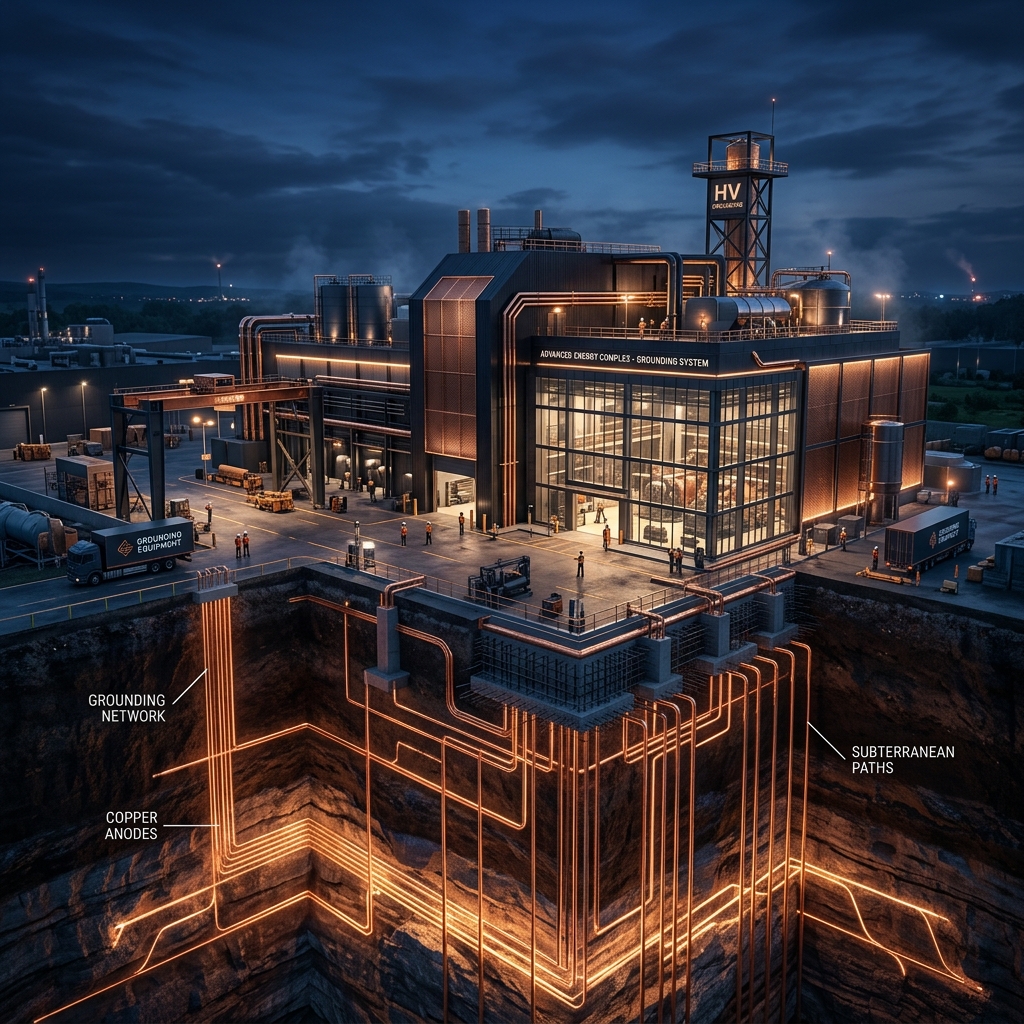
Massive infrastructure developments in the Middle East (NEOM, Red Sea Project), North Africa, and Central Asia face extreme geological conditions. In arid deserts, dry silica sand exhibits soil resistivity exceeding 2,000 to 5,000 $\Omega\cdot\text{m}$, while mountainous regions present solid granite and basalt bedrock with negligible topsoil.
Attempting to achieve the standard < 1.0 Ω substation earthing requirement using conventional pipe earthing in such terrains is virtually impossible without specialized chemical grounding technologies.
2. Proven Engineering Solutions for Extreme Terrains
   ┌─────────────────────────────────────────────────────────────┐
   │ ENGINEERED TERRAIN REMEDIATION TOOLKIT                     │
   ├─────────────────────────────────────────────────────────────┤
   │ 1. Deep Drilled Borehole Chemical Electrodes (30m to 60m)   │
   │ 2. Carbonaceous Earth Enhancement Compound (<0.05 Ω·m)      │
   │ 3. Deep Earth Wells tapping Aquifers                        │
   │ 4. Horizontal Radial Counterpoise Grids with BFC Encasement │
   └─────────────────────────────────────────────────────────────┘
A. Deep Borehole Earthing with Carbonaceous Compounds
When the surface soil is dry sand (3,000 Ω·m) but a conductive water-bearing aquifer exists 30 meters below, vertical drilling rigs sink deep boreholes. Copper-bonded rods are connected via threaded couplers, lowered into the aquifer, and fully grouted with non-shrinking Carbon Earth Enhancement Compound (resistivity $< 0.05\;\Omega\cdot\text{m}$).
B. Chemical Moisture-Retaining Compounds vs Bentonite in Deserts
While natural bentonite clay requires moisture to remain conductive (and shrinks/cracks in arid desert heat), engineered carbon-based backfill compounds (IEC 62561-7) do not rely on moisture. Their carbon-graphite crystalline matrix conducts electricity electronically, maintaining stable resistance indefinitely.
3. Real-World Case Study: 132kV Substation on Basalt Rock
Designing an Earthing or Lightning Protection System?
Connect with Sprexo International's senior electrical engineers for soil resistivity analysis, IEEE 80 / IS 3043 grid sizing, BOQ estimation, and turnkey project supply.
Related Technical Publications
 Earthing Engineering
Why Earthing Systems Are the Backbone of Electrical Safety: An Engineering Deep-Dive
 Materials & Specs
Types of Earthing Electrodes: A Practical Selection & Sizing Guide
 Electrical Safety