
Types of Earthing Electrodes: A Practical Selection & Sizing Guide
Chemical electrodes vs. copper-bonded rods vs. HDG GI pipes — choosing the optimal solution for your soil.
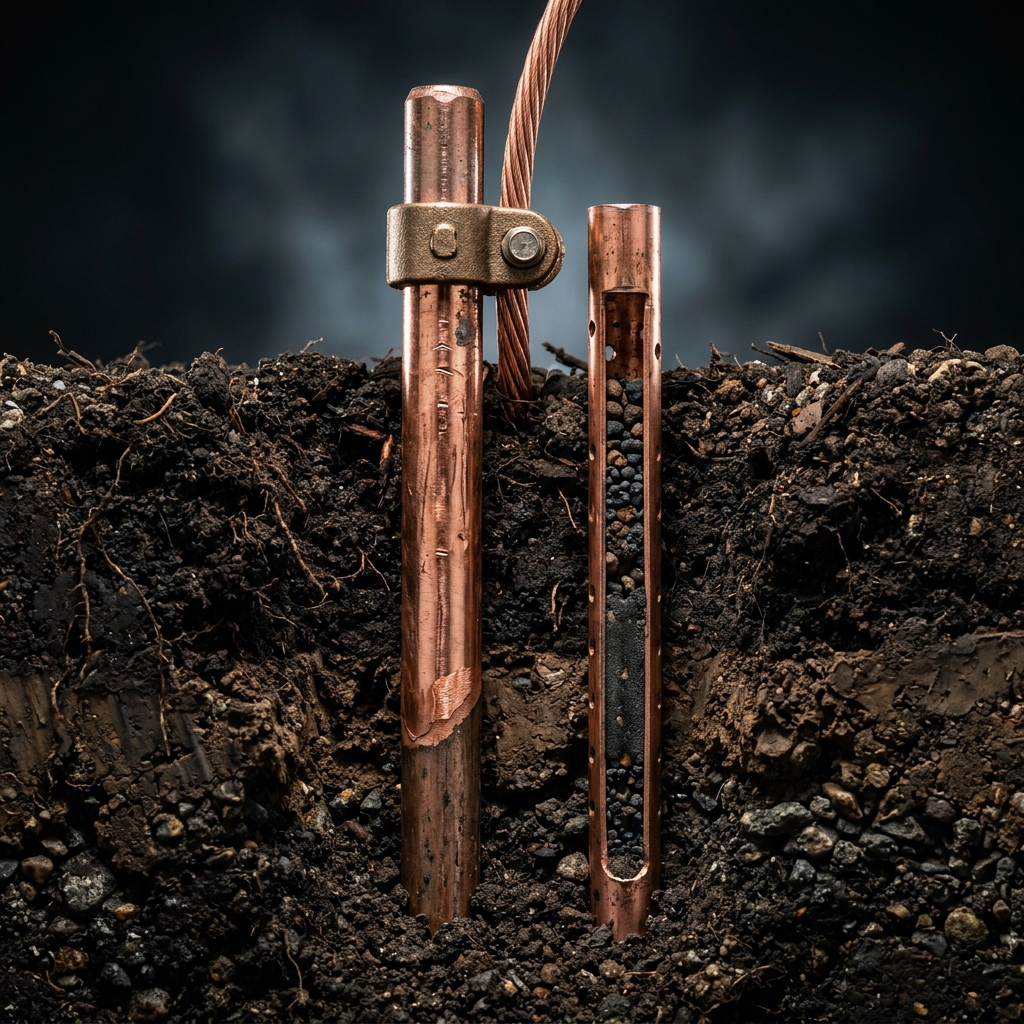
1. Overview of Modern Earth Electrodes
Selecting the correct earth electrode is one of the most critical decisions in electrical design. An incorrectly chosen electrode will either corrode prematurely in aggressive soil, fail to dissipate high fault currents, or result in high resistance that trips sensitive relays.
Under IS 3043:2018 and IEC 62561-2, earth electrodes are categorized by their geometry (rod, pipe, plate, or strip) and metallurgical construction (galvanized mild steel, copper-bonded steel, solid copper, or chemical compound-filled pipe).
2. Deep-Dive into Electrode Types
A. Chemical Earthing Electrodes (Pipe-in-Pipe / Strip-in-Pipe)
Chemical electrodes represent a quantum leap over traditional salt-and-charcoal GI pipe systems. They consist of a primary hollow outer pipe (GI or Copper-Bonded) containing a secondary inner conductor pipe or copper strip. The intermediate annular space is pressurized with non-corrosive, highly conductive crystalline mineral salts.
   ┌──────────────────────────────────────────────┐
   │ Outer Pipe (HDG / Copper Bonded)             │
   │  ┌────────────────────────────────────────┐  │
   │  │ Crystalline Moisture-Retaining Mineral │  │
   │  │   ┌────────────────────────────────┐   │  │
   │  │   │ Inner Conductor (Cu / GI Strip)│   │  │
   │  │   └────────────────────────────────┘   │  │
   │  └────────────────────────────────────────┘  │
   └──────────────────────────────────────────────┘
Working Mechanism:
B. Copper-Bonded Steel Earth Rods (UL 467 / IEC 62561-2)
Copper-bonded steel rods combine the high mechanical tensile strength of high-grade low-carbon steel (approx. 600 N/mm²) with the extreme electrical conductivity and corrosion resistance of 99.9% pure electrolytic copper.
Manufacturing Process:
The copper layer is applied using an electro-plating continuous molecular bonding process. Unlike cheap sheathed or copper-clad rods (which separate under impact), molecularly bonded copper will not tear, peel, or crack when driven deep into rocky subsoil with percussion hammers.
C. Heavy-Duty Galvanized Iron (HDG GI) Pipe Electrodes
Traditional GI pipe earthing employs a Class B or C mild steel pipe with hot-dip galvanizing (70 to 100 microns). Perforations along the length allow water ingress, and a cast-iron funnel with wire mesh is fitted at the top.
Limitations in Modern Installations:
D. Solid Electrolytic Copper Rods
Manufactured from 100% pure ETP grade copper (BS EN 50164-2). They offer unmatched current-carrying capacity and immunity to chemical attack in marine coastal zones, chemical processing plants, and hospital MRI grounding. However, because pure copper is ductile, solid copper rods cannot be driven into hard rock without pre-drilling boreholes.
3. Comprehensive Comparison Matrix
| Parameter | Chemical Earthing Electrode | Copper-Bonded Rod (250μm) | HDG GI Pipe Electrode | Solid Copper Rod |
|---|---|---|---|---|
| Material Base | GI / Cu-Bonded + Chemical Core | Low Carbon Steel Core + 99.9% Cu | Mild Steel + Hot Dip Zinc | 100% Pure ETP Copper |
| Tensile Strength | High (450 N/mm²) | Extreme (600 N/mm²) | High (410 N/mm²) | Moderate (220 N/mm²) |
| Service Life | 15 – 20 Years | 25 – 30 Years | 5 – 8 Years | 30+ Years |
| Maintenance | Zero Maintenance | Periodic pit check | Frequent manual watering | Zero Maintenance |
| Ideal Soil | Rocky, sandy, high resistivity | Deep soil, substations, towers | Normal non-corrosive soil | Coastal saline, acidic chemical |
| Governing Code | IS 3043 / IEC 62561-2 | UL 467 / IEC 62561-2 | IS 3043:2018 | IS 3043 / BS EN 50164 |
4. Mathematical Calculation of Earth Resistance
For a single vertical rod or pipe electrode driven into uniform soil of resistivity ρ (Ω·m), the earth resistance R is calculated using the Dwight / IS 3043 formula:
Where:
Engineering Observation:
Notice that doubling the length ($L$) reduces earth resistance by nearly 45% to 50%, whereas doubling the diameter ($d$) only reduces resistance by 10% to 15%. Therefore, deep driven copper-bonded rods or deep chemical boreholes are vastly more cost-effective than simply increasing electrode diameter.
5. Best-Practice Installation Guidelines
Designing an Earthing or Lightning Protection System?
Connect with Sprexo International's senior electrical engineers for soil resistivity analysis, IEEE 80 / IS 3043 grid sizing, BOQ estimation, and turnkey project supply.
Related Technical Publications
 Earthing Engineering
Why Earthing Systems Are the Backbone of Electrical Safety: An Engineering Deep-Dive
 Electrical Safety
Essential Electrical Safety Equipment for High-Voltage Switchgear Rooms
 Lightning Protection