
Global Trends in Electrical Safety: Harmonizing IEC, IEEE, and Regional Grid Codes
How multinational EPC contractors manage cross-border compliance across Asia, Middle East, and Europe.
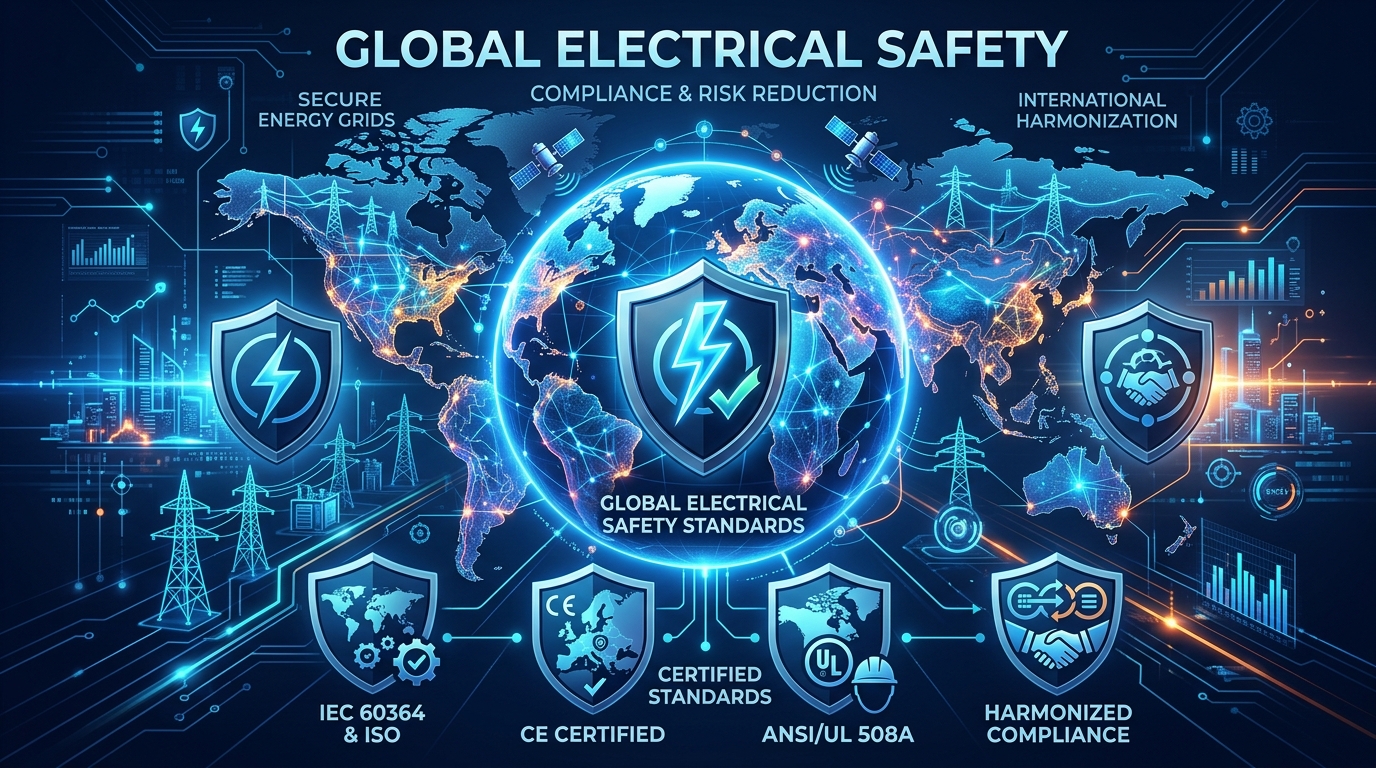
1. The Global Convergence of Electrical Engineering Standards
As infrastructure investments, cross-border grid interconnections, and renewable energy mega-projects expand across the Middle East, Africa, and Southeast Asia, electrical design engineers increasingly encounter conflicting regional standards.
A project designed by a European EPC firm may reference IEC 60364 and IEC 62305, while the project financier (e.g., US development banks or GCC state utilities) mandates IEEE 80, IEEE 142 (Green Book), and NFPA 70 (NEC).
2. Reconciling Core Technical Differences
   ┌─────────────────────────────────────────────────────────────┐
   │ COMPARING THE TWO DOMINANT GLOBAL PARADIGMS                 │
   ├──────────────────────────────┬──────────────────────────────┤
   │ IEC PHILOSOPHY (Europe/Asia) │ IEEE / ANSI PHILOSOPHY (USA) │
   ├──────────────────────────────┼──────────────────────────────┤
   │ • Performance-based framework│ • Prescriptive, mathematical │
   │ • Modular components         │ • Extensive empirical models │
   │ • TT, TN-S, TN-C-S systems   │ • Solidly vs Resistor Ground │
   │ • Rolling sphere & mesh focus│ • Step/touch potential focus │
   └──────────────────────────────┴──────────────────────────────┘
A. Substation Safety Limits: Body Weight Assumptions
B. Earthing System Architectures:
3. The Impact of Smart Grids and Renewable Microgrids
Modern renewable grids with bi-directional inverter power flow introduce complex harmonic distortions and high-frequency transient switching. Traditional 50Hz grounding models are evolving to account for High-Frequency Ground Impedance ($Z_g$), where inductive reactance (X_L = 2π f L) dominates over pure DC resistance (R).
4. Key Recommendations for International EPC Contractors
Designing an Earthing or Lightning Protection System?
Connect with Sprexo International's senior electrical engineers for soil resistivity analysis, IEEE 80 / IS 3043 grid sizing, BOQ estimation, and turnkey project supply.
Related Technical Publications
 Earthing Engineering
Why Earthing Systems Are the Backbone of Electrical Safety: An Engineering Deep-Dive
 Materials & Specs
Types of Earthing Electrodes: A Practical Selection & Sizing Guide
 Electrical Safety