
Grounding & Lightning Protection for Utility-Scale Solar PV Farms & Wind Turbines
Protecting gigawatt-scale renewable assets from lightning surges, ground faults, and PID degradation.
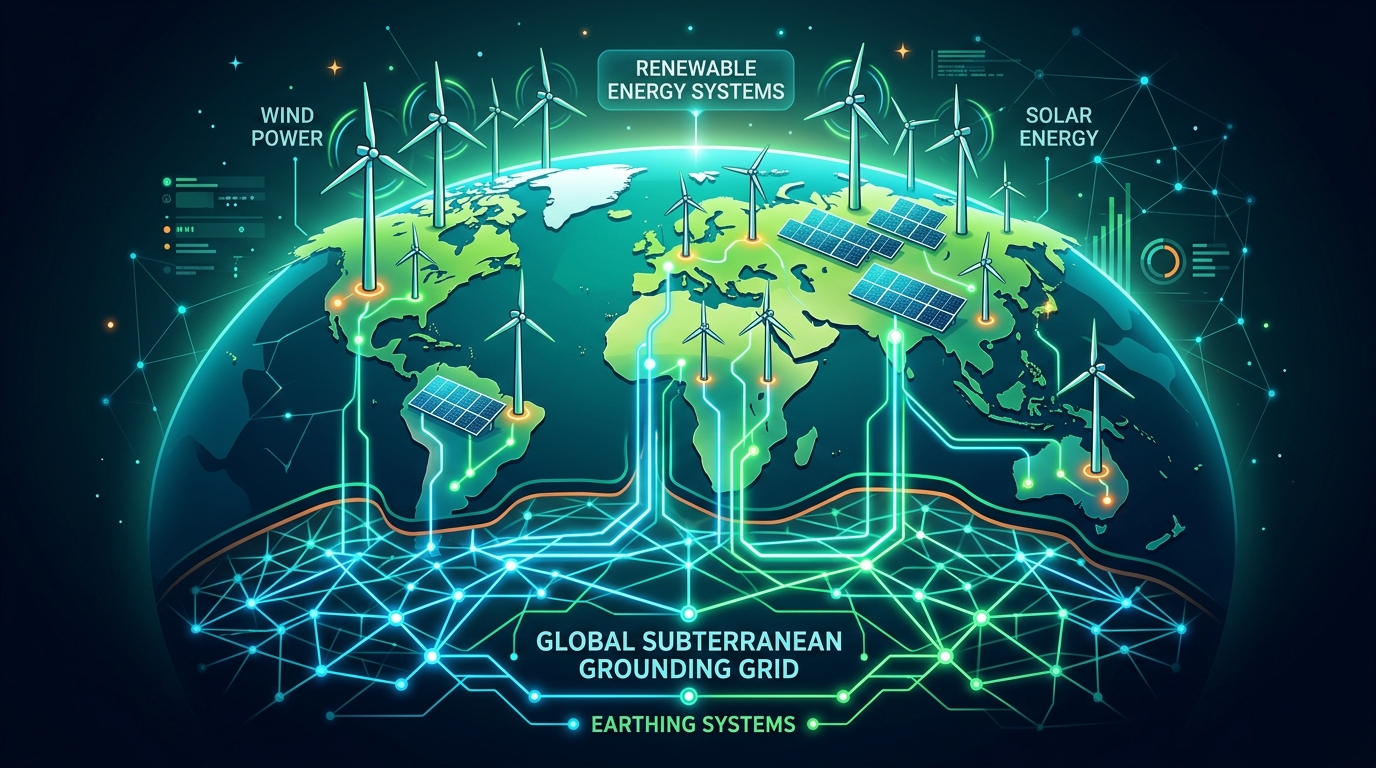
1. The Unique Grounding Challenges of Renewable Mega-Projects
Utility-scale solar farms (50MW to 1,000MW+) span hundreds of acres of open, flat terrain. Because solar modules are mounted on metal structures in open fields, they represent massive targets for direct and indirect lightning strikes.
Furthermore, solar PV systems operate with high DC voltages (up to 1,500V DC), where DC ground faults do not have natural zero-crossings, making arc extinguishing significantly harder than in AC systems.
2. Solar PV Grounding Architecture (IEC 62548 / NEC 690)
  [ Solar PV Modules (Aluminium Frames) ]
                   │
  [ Module-to-Module Grounding Clips (WEEB) ]
                   │
  [ Tracker Steel Torque Tube / Purlins ]
                   │
  [ Flexible Copper Earth Braid Jumper across Pivot Bearings ]
                   │
  [ HDG GI Earthing Strip Running Along String Rows ]
                   │
  [ Central Earth Pit & Inverter Transformer Station ]
A. Equipotential Bonding of Solar Trackers:
Single-axis trackers rotate continuously throughout the day. Rotating bearing joints can create high-resistance gaps. Flexible tin-plated copper earth braids must bridge all rotating joints to maintain continuous earth bonding.
B. Mitigating Potential Induced Degradation (PID):
In modern high-efficiency mono-PERC and TOPCon solar modules, high voltage potential between the solar cells and grounded frame causes stray ion leakage, resulting in severe power loss known as PID. Engineered functional grounding or negative-bias grounding units are essential to prevent PID degradation.
3. Wind Turbine Generator (WTG) Grounding (IEC 61400-24)
A modern 3MW to 6MW wind turbine stands over 120 to 150 meters tall with composite fiberglass blades.
Designing an Earthing or Lightning Protection System?
Connect with Sprexo International's senior electrical engineers for soil resistivity analysis, IEEE 80 / IS 3043 grid sizing, BOQ estimation, and turnkey project supply.
Related Technical Publications
 Earthing Engineering
Why Earthing Systems Are the Backbone of Electrical Safety: An Engineering Deep-Dive
 Materials & Specs
Types of Earthing Electrodes: A Practical Selection & Sizing Guide
 Electrical Safety